Why Olive Wood Shows Its Grain Differently from Board to Bowl
Olive wood grain changes from board to bowl as sawing and turning reveal different fibres, helping you read the pattern without mistaking it for quality.
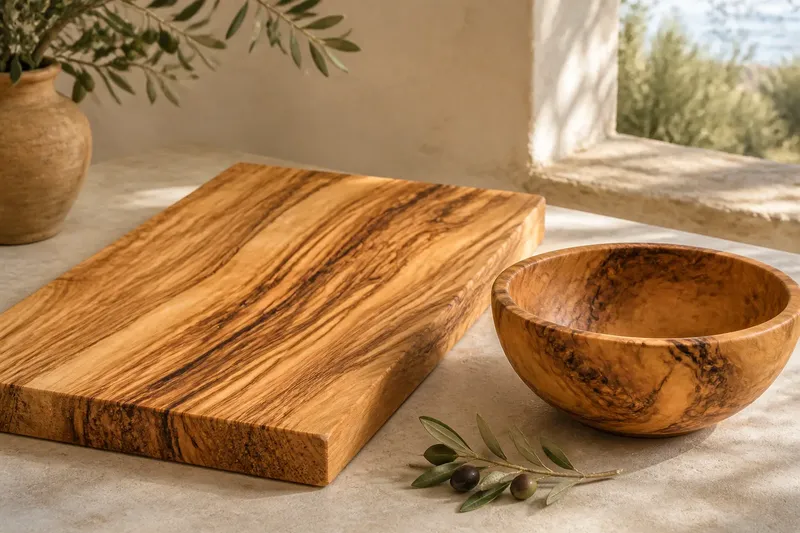
At a kitchen table, an olive-wood board may show long, quiet bands, while a small turned bowl beside it seems to hold knots, curls and shifting streaks. Olive wood grain changes from board to bowl because sawing and turning expose different directions through the same timber. Following those directions makes the patterns easier to understand—and keeps appearance separate from a judgement of quality.
Grain follows the tree
Wood is not a uniform material with decorative lines painted through it. Its fibres grew along the tree’s length, while growth rings and changes in colour cross or interrupt that general direction. When a piece is sawn or carved, the surface becomes a window onto those structures. Move the cut and the view changes.
Olive wood can show strong variation within a single piece. Pale areas may sit beside darker brown streaks; curved marks can gather around former branches or follow changes in the trunk. That visual variety reflects the tree’s growth and the cut’s position, not a simple scale from plain to superior.
On a board, the broad face is often cut so that the tree’s length runs along the board. The grain may appear as extended lines or ribbons. The end grain at a board’s edge, by contrast, shows the ends of the fibres as small marks. Even without knowing the exact cut, comparing the broad face with an edge makes the change in orientation apparent.
A board is also a relatively flat plane. It presents a continuous view across its surface, so the eye can follow a band for some distance. A bowl curves away from the viewer and gathers several orientations into one object. Its pattern can seem more animated even when the wood is no more varied.
A board presents a plane
Boards are usually made by sawing a log into slabs or planks. The saw’s path determines which part of the tree’s structure appears across the face. A cut running roughly parallel to the trunk’s length can expose long grain; another angle can reveal curved or more closely spaced marks. The board’s outline and the direction of its fibres are related, but they are not the same thing.
A maker may also join smaller pieces to form a larger board. In that case, neighbouring sections can show different directions or tones. A seam, a shift in line, or a repeated arrangement may reveal how the pieces were composed. Such changes describe the object’s construction, not whether it is suitable for its intended use.
When looking at a board, notice whether the lines run with its long edge, cross it, or bend around a darker feature. Then look at the narrow side. If the marks there appear as short flecks rather than long bands, you are seeing a different face of the fibres. This small comparison is more informative than trying to assign a quality label to a striking pattern.
Oil or a clear finish can deepen the contrast between lighter and darker regions. It may also make the grain easier to see under ordinary room light. The finish changes the surface’s appearance; it does not change the direction in which the tree’s fibres grew.
Turning brings angles together
A turned bowl begins as a block mounted on a lathe. As the wood rotates and the cutting tool shapes the outside and interior, the finished surface curves across the block. The cut therefore meets the fibres at changing angles. A line that looks straight on one part of the bowl may arc, widen or disappear as the surface turns away.
The rim, sides and base can each expose a different view. At the rim, the cut may reveal a cross-section of fibres; farther down the wall, the surface may follow them more lengthwise. The base can present yet another orientation, depending on how the blank was prepared and mounted. The result is not one pattern stretched evenly over a vessel, but a set of connected views.
Imagine a maker turning a square olive-wood blank whose darker streak runs diagonally across one face. As the corners are shaped into a bowl, the streak may pass from the rim towards the wall, then curve out of sight beneath the base. The expected visible result is a pattern that changes around the bowl, although the blank came from one piece of wood. The precise appearance depends on the blank’s position and the cut.
Turning also changes what the eye treats as a line. On a flat board, a stripe can be followed from one end to the other. On a rounded bowl, the same stripe may be broken by the curve, reflections or the viewing angle. Rotating the object slowly in natural light can help distinguish a continuing band from a surface reflection.
Figure is not a score
Terms such as straight grain, curly grain and figured grain describe visible arrangements; they are not universal grades of craftsmanship. A lively pattern may catch attention, while a quieter one may suit a simple form. Neither appearance alone establishes how carefully the object was made or how it will serve its purpose.
Likewise, a knot or dark streak is not automatically a defect. Its significance depends on the object, its construction and the maker’s choices. A mark can be part of the wood’s natural variation, while a separate concern might involve a loose joint, an unstable base or a crack that affects the object’s use. Those are different observations and should not be collapsed into a verdict based on grain alone.
For a board intended for food preparation, look at the whole surface and consider its care instructions, construction and condition, rather than treating dramatic grain as evidence of suitability. For a turned bowl, consider its form, finish and intended use. If a label or maker’s instructions specify care, follow those directions; requirements can differ by finish and construction.
There is also a cultural dimension to the appeal of olive wood. In goods associated with Italy, its grain often serves as a visible reminder that the object comes from a living tree rather than a repeatable sheet of material. That association can make variation feel meaningful, but it should not be mistaken for proof of origin. Appearance alone cannot establish where a particular object was made or where its wood was grown.
What should you look for?
Use these observations to read the surface, not to assign a grade. Each one pairs a visible feature with a sensible next decision.
- Check whether bands on the board’s broad face run with its long edge; if they do, compare them with the narrow edge to see the change in fibre direction, and if they do not, follow a band across the face before drawing conclusions about the cut.
- Check the board’s narrow edge for short flecks or small end-grain marks; if they are visible, treat the edge as a view across the fibres, and if the edge is covered or finished too darkly to read, rely on the broad face rather than guessing.
- Check whether a seam or abrupt shift divides the board’s pattern; if it does, regard the surface as joined pieces and inspect the join for an obvious opening, and if no seam is visible, do not assume that the board came from one uninterrupted piece.
- Check whether a dark streak on a bowl continues from rim to wall as you rotate it; if it does, follow its changing curve around the form, and if it disappears, alter the viewing angle before treating it as a separate mark.
- Check whether a bright band moves when the bowl or light moves; if it shifts with the reflection, read it as a likely surface highlight, and if it stays in the wood’s pattern, follow the grain instead.
- Check for a crack, loose joint or unstable base separately from colour and figure; if one affects ordinary handling or use, ask the seller or maker about the object’s condition, and if none is apparent, judge the pattern only as appearance.
- Check the maker’s care directions and stated intended use; if they specify limits or particular cleaning, follow those directions, and if no guidance is supplied, ask the maker or seller rather than assuming that every finish suits the same use.
Questions about olive wood grain?
Why does a bowl look more varied than a board?
A bowl’s curved surface reveals the wood at changing angles, while a board offers a broad, relatively flat face. The turning process can bring lengthwise and crosswise views together, making one piece appear to contain several patterns.
Does darker olive wood mean better quality?
No single colour or grain pattern serves as a dependable quality rating. Read appearance as information about the wood and its cut, then judge the object separately by its construction, condition and intended use.
Why do the stripes seem to move as I turn a bowl?
The wood’s pattern stays in place, but the curved surface changes its angle to your eye and to the light. Turning the bowl changes which part of that surface is visible, so bands can seem to bend, narrow or vanish.
Can grain show where an olive-wood object was made?
Grain can reveal growth and cutting patterns, but it cannot by itself identify a workshop or place of manufacture. For provenance, look for clear information from the seller or maker rather than inferring origin from colour and figure.
Read the changing surface
Say you are looking at a board with long brown bands and a small bowl with a similar streak near its rim. First, follow one band across the board’s broad face; then compare it with the short marks on the edge, which show a different orientation. Next, rotate the bowl under steady natural light and follow the rim streak down the wall. If it bends or vanishes while the wood itself remains in view, the curve and cut are changing your view of the grain; if a bright line shifts with the light, it is a reflection rather than a continuing stripe. The result is a clearer distinction between fibre direction, surface figure and reflected light, without treating any of them as a quality verdict.
Olive wood grain changes from board to bowl because each shape presents the fibres at different angles. The grain can help explain how the surface was cut and why a flat band becomes a shifting figure. It cannot, on its own, decide whether an object is well made, fit for a particular task or genuinely Italian; those judgements call for different evidence.