Italian Travel Souvenirs and the Work They Leave Behind
Italian travel souvenirs carry more than a place-name: learn how to read their materials, original uses and personal histories without mistaking them for local craft.
A postcard from Florence is tucked into a guidebook beside a pencilled street name. Its picture may have been chosen as a memento, while the book helped its owner find a church or a station. Italian travel souvenirs often hold these different roles at once: they can be tools, gifts, records of a visit or objects made for display.
That variety makes it hard to tell a simple story in which useful objects gradually turned into keepsakes. A guidebook and a devotional image serve different purposes; a postcard may travel by post, while a ceramic vessel may be used at home. The more helpful question is what a particular object was made to do, how it travelled, and what later owners made of it.
Uses on the journey
Some objects associated with travel had practical or social functions from the outset. A guidebook could direct a visitor through unfamiliar streets. A ticket marked a journey taken, and a postcard sent news as well as an image. A devotional image or pilgrimage token might belong to a religious practice, not simply commemorate a visit.
These objects do not form a single historical sequence. Their functions depend on their type and context, and an item could be useful and memorable at the same time. A ticket might be needed for passage, then kept in a drawer; a postcard might be written to a friend and later saved in a family album.
For an object made by a craft worker, its connection to a place begins with its material, form and making. A visitor may encounter it through a shop or market, but buying it does not reveal the whole story of its production. Nor does a place-name or familiar motif, by itself, establish where or how it was made.
From making to keepsake
“From workshop to keepsake” is best understood as a change in an object’s setting and use, not as a documented progression shared by every Italian souvenir. A vessel made for everyday use may be bought by a visitor and carried home as a reminder. A print made to be sold to travellers may already have been intended as a keepsake. The path varies with the object, maker, seller and buyer.
After a journey, the owner may use an item as before, put it on a shelf, or pass it to someone else. These choices add personal associations, but they do not replace the object’s material history. A ceramic piece can prompt memories of a trip while remaining a ceramic object whose production cannot be inferred from the memory alone.
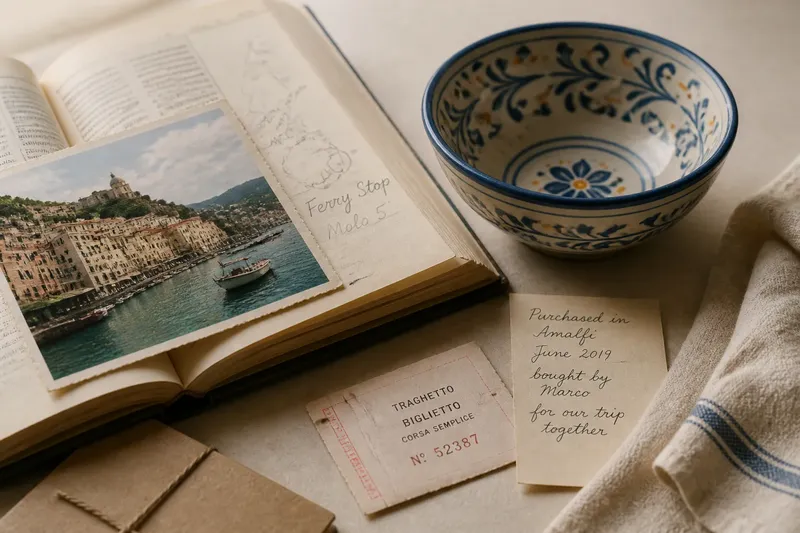
Say you return from a coastal town with a harbour postcard, a guidebook with a ferry stop pencilled in, and a small ceramic bowl bought at a shop. The guidebook served as a route aid; the postcard carried a view that you later pin beside your desk; the bowl becomes part of a meal at home. Each item takes a different route from travel to later use, and none proves anything about local production without further information.
Reading the object
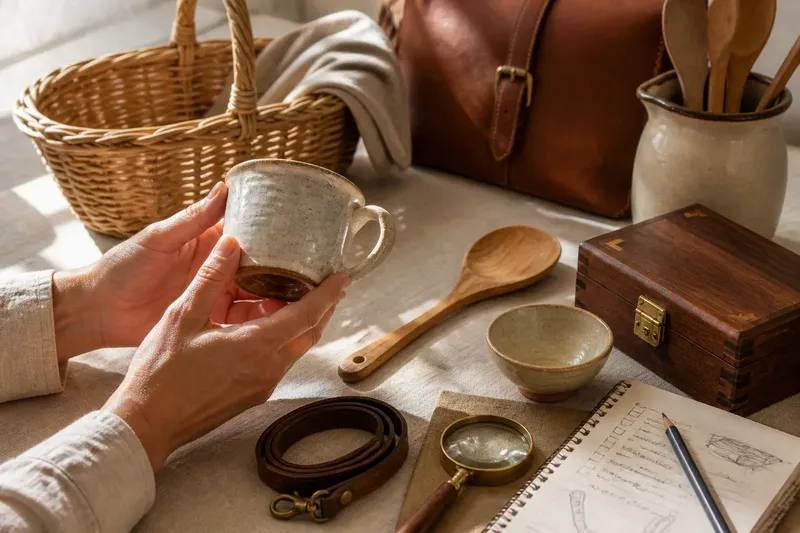
Look first at what can be observed, then separate that from what you have been told. A maker’s mark, label or receipt may offer clues, but a decorative motif alone is not evidence of origin. Wear can suggest handling, though it cannot identify who used an object or when.
For a household collection, a short note can preserve context that the item cannot carry by itself. Record the place where it was acquired, the name on any label, the occasion and the person who brought it home. If the details are uncertain, mark them as uncertain rather than turning a family recollection into a firm account.
- Check for a maker’s mark or label. If it names a maker or place, keep a photograph or transcription with the object; if there is no mark, leave the maker and origin unidentified rather than guessing.
- Check the material and construction. If the material is clear from ordinary observation, describe it plainly; if it is uncertain, avoid identifying it by appearance alone and seek a knowledgeable conservator or seller before making a firm claim.
- Check for signs of use. If folds, fading or worn edges are present, note them as visible condition; if there are no such signs, do not infer that the object was never handled.
- Check any purchase record. If a receipt or card gives a shop or location, keep that information with the object; if no record survives, describe the acquisition place as unknown.
- Check whether the item still serves a purpose. If it is used as a cup, cloth or guidebook, record that continuing role; if it is displayed or stored, describe where it is kept instead of assuming why.
- Check whose memory is attached to it. If a named person or occasion is remembered, write down the account and who supplied it; if accounts conflict or are absent, preserve that uncertainty.
These checks are ways to describe an object carefully, not a method for authenticating it. For a significant purchase or a disputed attribution, consult a qualified specialist rather than relying on a souvenir’s appearance or family story.
Souvenir questions?
Does an Italian souvenir need to be handmade?
No. A printed postcard or ticket can hold a personal history without being handmade. If you want to know whether an item is artisan-made, look for reliable maker information rather than treating its style as proof.
Can a useful object also be a keepsake?
Yes. A guidebook, cup or cloth can remain useful while reminding its owner of a journey. The object’s role can change without its earlier use disappearing.
Does a regional motif prove where an object was made?
No. A motif may refer to a place without identifying the maker or production site. A label, maker’s information or other reliable documentation is a stronger basis for describing origin.
How should an inherited souvenir be described?
Separate what is visible from what relatives remember: note the object’s material and condition, then record the account and who shared it. If the journey or maker is unknown, say so rather than filling the gap with a plausible-sounding story.
Italian travel souvenirs are easiest to understand when their several histories are kept distinct: what they were made to do, how they were acquired, and what they came to mean at home. A postcard, ticket or bowl can carry a memory without standing for an entire town or craft tradition. A modest note beside the object—naming what is known and leaving the rest open—can make that distinction clearer for the next person who holds it.