A Seasonal Reset for Small Household Objects
A seasonal reset for small household objects helps you sort keepsakes, kitchen tools and everyday odds and ends into clear, usable places without replacing them.
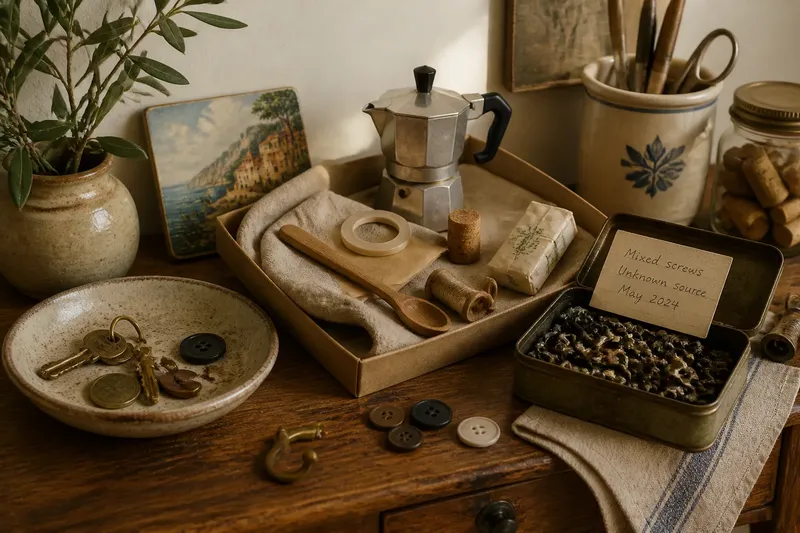
A brass key ring catches on a coat as you reach for it; nearby, a small ceramic dish holds a button and a coin from another country. A seasonal reset for small household objects starts with this kind of everyday jumble: one surface cleared enough to see what is there, and a little time to decide what each thing is for.
Gather a small group
Choose one contained area: a hall table, a kitchen drawer or the shelf where keys and glasses land. Bring together only the small objects that belong there. A shallow cardboard box or a tea towel makes a temporary landing place; sweeping through the whole home can turn a manageable task into an exhausting one.
Keep the first categories loose. Put keys with keys, fasteners with fasteners, and keepsakes together. Italian household goods might include a moka pot’s spare gasket, a cork stopper from an olive-oil bottle, a wooden spoon or a paper-wrapped packet of matches from a trattoria. Their origins may matter to you, but begin by asking whether each item has a use, a home or a reason to be kept.
Imagine you find a small brass hook mixed with loose buttons in a hall drawer. You place it with other hardware, check whether it fits a repair you already have in mind, then put it in the repair tin if it does; if not, you set it aside to pass on or let go. The result is a drawer in which buttons and hardware are easier to distinguish, rather than a new set of containers to manage.
Respect material histories
Small objects often carry more than a practical function. A chipped souvenir tile may recall a particular journey, while a cork stopper or moka-pot part points to repeated household routines. Treating each object as a prompt to consider its use, memory or cultural association gives this reset a different purpose from simply sorting by condition.
Keep those meanings distinct where it helps. A keepsake need not justify itself as a useful tool, and a worn utensil need not be kept as a souvenir if it no longer feels significant. Give each object a place that reflects the reason it remains: a visible shelf for a tile, a drawer beside the coffee equipment for a spare gasket, or a small box for travel mementos.
Clean within limits
Start with dry dusting using a soft brush or clean, dry microfibre cloth. This is the lowest-risk first action for objects whose material or finish is uncertain. Do not assume that a surface can tolerate moisture because it looks solid: painted decoration, joins, labels, metal fittings and old finishes may react differently from the main material.
Use a damp cloth only when the maker’s care instructions permit it and the item is a plain, non-porous surface without vulnerable decoration or joins. Wring the cloth until it is barely damp, wipe a discreet area first, and stop if colour transfers, the finish changes or moisture catches at an edge. Keep this approach separate from food-contact cleaning: a dry dusting cloth is not a substitute for washing a utensil that has touched food.
For wooden spoons and other food-contact utensils, follow the maker’s directions. If none are available, wash the utensil by hand with washing-up liquid and water, rinse it, then dry it promptly; do not leave it soaking or put it in a dishwasher unless its instructions allow that. If wood is cracked, splintered or difficult to clean, stop using it for food and seek suitable advice about repair or disposal.
For a fragile, valuable or historically significant object, avoid further cleaning when its finish is uncertain and consult a conservator or another qualified specialist. Abrasive pads, solvents and polishing compounds can alter surfaces, so they are not a sensible first choice for an object whose materials or history are unclear.
Choose a clear destination
Give each item one of a few destinations: return to use, repair, relocate, pass on or let go. For each, check the observation and make the corresponding decision; if the result does not fit, choose the alternative rather than returning the item to an undefined pile.
- Return to use: Check whether the item is intact and has a current task. If it does, return it near that task; if it does not, move it to repair, pass it on or let it go.
- Repair: Check whether the fault and any loose parts are identifiable. If they are, store the item with those parts and a note; if they are not, seek advice or choose another destination.
- Relocate: Check whether the item is repeatedly used in a different room. If it is, move it there; if not, keep it where it is used or reconsider whether it belongs in the home.
- Pass on: Check whether the object is clean, usable and suitable for someone else. If it is, offer it to a person or local reuse route; if it is not, do not pass on an item that is broken or unsuitable.
- Let go: Check whether the item is broken, unsafe or no longer serviceable. If it is, use the appropriate local disposal route; if it is still usable, consider repair, reuse or passing it on instead.
- Keep as a keepsake: Check whether a specific memory or association is the reason you want it. If it is, give it a stable place with other mementos; if it is not, consider whether it belongs with supplies or should leave the area.
Say you find a moka pot gasket in a drawer with loose screws. The starting items are one gasket, several screws and a moka pot on the kitchen shelf; you first compare the gasket with the pot’s existing part and find that it is the matching spare, then place it in a small envelope beside the pot. The screws do not belong to that appliance, so you put them in the household repair tin and add a note if their source is unclear. The result is a useful spare kept with its object, while unrelated hardware remains separate; if the gasket does not fit, the alternative is to identify its intended pot before storing it rather than assuming it belongs there.
Make homes easy to restore
A useful storage place is close to the moment of use and easy to return things to. A small dish by the entrance can hold keys; if receipts begin to collect there, move them to a paper-sorting spot rather than letting the dish become a general landing zone. A kitchen tray can gather bottle stoppers or clips if its purpose is clear and it is easy to empty.
Use one modest container for small items that travel between rooms. A reused tin can hold sewing notions; a sturdy jar can gather clean corks intended for a particular craft or garden use. If you cannot name the use or a reasonable place to store the material, do not keep adding to the container.
Keep keepsakes apart from supplies. A souvenir spoon or hand-painted tile may earn its place through memory rather than frequent use. Give it a stable, visible spot where it will not be knocked against tools or buried under spare batteries. The point is not to make every object useful, but to make its reason for staying legible.
Questions about resets?
How often should I reset small household objects?
Choose a seasonal cue that already fits your home, such as changing coats or clearing a kitchen shelf. Repeat the reset sooner if a particular drawer becomes difficult to use.
Can I clean old or handmade pieces at home?
Begin with dry dusting and do not apply water, solvents or polish when the finish is uncertain. For a fragile, valuable or historically significant object, ask a conservator or qualified specialist before cleaning further.
What should I do with an object I might repair?
Keep the object with any loose parts and a note describing the fault. Leave electrical, gas, structural or other safety-critical work to a qualified professional.
When is it sensible to keep spare materials?
Keep them when you can name a specific use and give them a suitable storage place. If corks, fabric offcuts or spare fasteners accumulate without a purpose, pass them on or let them go.
Leave room to notice
Return useful objects to their homes, put repair candidates somewhere deliberate and leave the working surface clear enough to use. That open space makes it easier to notice when new items begin to gather without a purpose.
A seasonal reset for small household objects is also a way to keep material histories visible without asking every object to do the same job. Once the last item is put away, leave one small patch of shelf or drawer space open; it gives the next stray object a pause before it becomes part of the clutter.